
Early signals
- Thinking about the next session frequently.
- Increasing deposits or stake size.
- Moving or ignoring a limit.
- Using gambling to change mood.
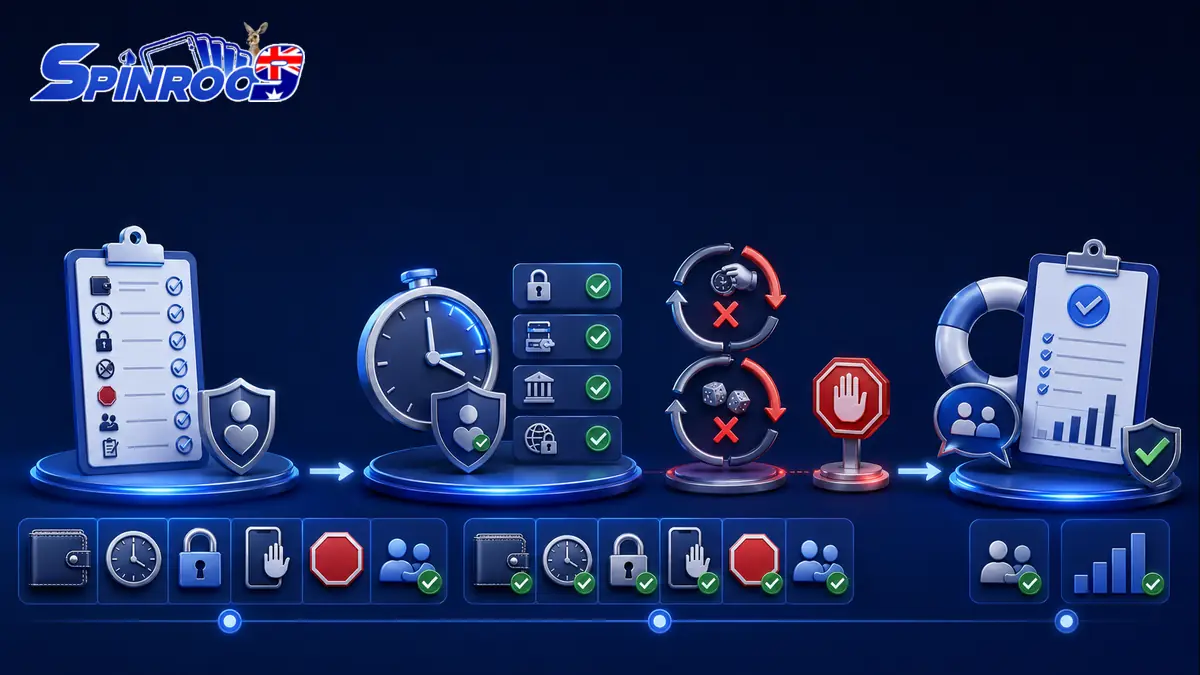
Responsible gambling is not a promise that gambling becomes harmless. It means using firm boundaries, noticing early warning signs and stopping or seeking help when control weakens.
Set money and time limits before gambling, never borrow or use essential funds, avoid chasing losses, take regular breaks and treat difficulty stopping as a reason to seek support. Gambling Help Online is free, confidential and available 24/7 across Australia.
Responsible gambling is a harm-reduction approach, not a guarantee of safety and not a test of personal strength. Gambling always places money or something of value at risk on an uncertain outcome. A person can follow several precautions and still experience harm; the correct response is to reduce or stop exposure, not blame the person for failing to “play responsibly enough”.
Practical boundaries are set before emotion, wins or losses change the decision. They cover money, time, payment access and the reason for gambling. The strongest boundary is sometimes not to gamble at all—particularly when funds are needed for essentials, the person is trying to recover debt, mood is unstable or previous limits repeatedly failed.
Gambling is paid entertainment with an uncertain outcome, never a method for earning income, repairing debt or recovering a previous loss.

A gambling budget is an entertainment amount that can be lost in full without affecting rent, food, utilities, transport, medicine, debt payments, savings goals or other people. It is not a target to spend and should not include credit, borrowed money, a cash advance or funds expected from a future win.
If a person cannot set an amount that is safe to lose, the affordable gambling budget is zero. That is a financial fact, not a moral failure.
Time changes perception. Fast rounds, continuous play, animation and easy redepositing can make spending difficult to track. Set both an end time and a maximum session length. Use an independent alarm, because an in-game reminder can be dismissed while attention is narrowed.
Add friction between a feeling and a payment: log out after a session, disable saved methods, remove promotional notifications and wait before any new deposit. A short pause is useful, but repeated urges, broken limits or returning immediately after self-exclusion signals that a longer break and professional support may be appropriate.
A player planned to stop at 9 pm but wins at 8:55 and decides the limit no longer applies. The safer rule is that the end time remains unchanged. A win affects the balance, not the reason the time boundary was set.
Harm can be financial, emotional, physical, social or occupational. It may appear before a crisis. Warning signs include spending more money or time than planned, hiding activity, borrowing, missing bills, feeling restless when trying to stop, gambling to escape distress, returning to recover losses and continuing after relationships or work are affected.
Anyone who feels in immediate danger should contact Australian emergency services on 000. For crisis support, Lifeline is available on 13 11 14. Gambling Help Online supports people affected by their own or another person's gambling.

Chasing losses means continuing, returning quickly or increasing the stake in an attempt to recover money already lost. The behaviour is understandable because a loss feels unfinished, but random outcomes do not know the amount a person wants back. A larger stake increases the amount at risk; it does not make recovery due.
A deposit offer after a loss can make returning feel discounted. It still requires more money to be placed at risk and may add wagering conditions. Do not use a bonus to pursue a previous result.
Useful account tools can include deposit, loss, wager and time limits, reality checks, cooling-off periods, marketing controls and self-exclusion. Their availability and rules vary. Set limits before play and choose a reduction that takes effect without an avoidable delay. Do not rely on a single operator tool if gambling occurs across several services.
BetStop—the National Self-Exclusion Register—lets people exclude themselves from all Australian-licensed online and phone wagering providers in one process. Its official scope is licensed wagering; it does not cover illegal online casino services. People may also need device blocking, bank controls and direct exclusions for other channels.
A self-exclusion is a protective action, not a punishment. Trying to evade it with another identity, offshore site or new payment method undermines the space it is designed to create. Ask a counsellor to help build a broader plan around triggers, money access and support.
Gambling Help Online provides free and confidential support 24/7 across Australia, including live counselling and information for family and friends. The Gambling Helpline is 1800 858 858. Local services can also provide face-to-face support, financial counselling and practical strategies.
BetStop is the Australian Government national self-exclusion register for licensed online and phone wagering providers. For general financial pressure, the National Debt Helpline can provide free financial counselling. Support services do not require a person to wait until every account is empty or a relationship is at breaking point.
| Need | Starting point | Action |
|---|---|---|
| Gambling urges or harm | Gambling Help Online / 1800 858 858 | Free confidential counselling and local referrals. |
| Licensed wagering self-exclusion | BetStop | Register for a chosen period from three months to lifetime. |
| Debt and bill pressure | National Debt Helpline | Speak with a free financial counsellor. |
| Immediate danger | Emergency services | Call 000; Lifeline is 13 11 14 for crisis support. |
A conversation is more useful when it focuses on observed impact rather than labels. Choose a calm time, describe specific changes—missed bills, distress, secrecy or absence—and listen. Do not loan money to cover gambling without a plan, take over debts secretly or threaten consequences that cannot be followed through.
Protect shared finances where appropriate: review joint accounts, direct essential payments, change vulnerable access and obtain independent financial or legal advice for major risks. The supporter also deserves counselling and boundaries. Gambling Help Online explicitly supports people affected by someone else's gambling.
“I've noticed the rent was late twice and you seem very stressed after using the betting app. I'm worried about you and our shared bills. Can we pause the payments and call a gambling counsellor together?” This is more actionable than debating whether the person is “an addict”.
Write the plan when calm and keep it outside the gambling account. If any item cannot be answered honestly, pause instead of depositing.
The most responsible choice can be not to begin. Learning game mechanics does not create an obligation to play, and walking away from an offer is not missing income.
It is a harm-reduction approach using money, time and access boundaries while recognising that gambling remains risky. It does not make gambling harmless or suitable as income, and stopping completely can be the right choice.
Protect essentials, debts and savings first. Choose only an entertainment amount affordable to lose in full, exclude credit and borrowing, record net spend and stop when either the money or time limit is reached.
Signs include broken limits, chasing losses, borrowing, hiding activity, missing bills, relationship conflict, distress and difficulty stopping. Seek support early rather than waiting for a crisis.
Treat the loss as completed spending, leave the payment and game screens, restrict access to funds, disable marketing and deposits, and contact Gambling Help Online if the urge is difficult to manage.
BetStop is the Australian Government national self-exclusion register for all Australian-licensed online and phone wagering providers. It does not cover illegal online casino services, so broader blocking and support may also be needed.
Gambling Help Online offers free confidential support 24/7 across Australia, and the Gambling Helpline is 1800 858 858. In immediate danger call 000; Lifeline is 13 11 14 for crisis support.