
How to Verify Casino Website Claims
Check legal entity, domain, regulator, service scope, payment and support statements.
use the gambling website verification checklistAustralian law distinguishes service categories. A website loading, accepting PayID or using Australian imagery does not establish that it may lawfully offer its service.
The Interactive Gambling Act 2001 regulates how gambling services are provided and advertised to people in Australia. ACMA states that some services—including online casino games and online slot-machine services—are prohibited from being offered to Australian customers, while licensed interactive wagering is a separate category.
Australia does not use one universal label for every gambling website. Federal law addresses interactive gambling service categories and advertising, while states and territories regulate matters such as venue gambling, lotteries, racing and wagering licences within their powers. Payment rules, consumer law, privacy and criminal law can also be relevant depending on the facts.
The key federal source is the Interactive Gambling Act 2001. The Australian Communications and Media Authority (ACMA) administers and enforces important parts of that framework. ACMA's public guidance says it is illegal for providers to offer certain online services to people in Australia. The legal question is therefore not answered by whether a consumer can reach the website or whether the operator uses an overseas licence.
This guide provides general information, not legal advice. Check current ACMA and legislation sources for the service at issue, and obtain qualified advice where a legal conclusion matters.

ACMA identifies prohibited interactive gambling services that include online casino-style games, online slot machines and certain in-play sports betting services when offered to customers in Australia. The statutory language and exceptions matter, so a marketing label such as “social”, “skill”, “sweepstakes” or “crypto casino” should not replace analysis of how the service actually works.
An offshore licence does not override Australian federal restrictions. It may establish that another jurisdiction issued an authorisation within its own scope, but it does not make a prohibited service lawful to supply to Australian customers. Likewise, a service stating “players are responsible for local laws” does not answer the provider's obligations under Australian law.
Do not write “100% legal in Australia” merely because a website is accessible, accepts Australian dollars, uses PayID or has an English-language support team. None of those facts is a legal determination.
ACMA maintains a register for licensed interactive wagering providers. This relates to wagering services such as betting, not a general approval list for online casinos. A company appearing on the wagering register does not automatically authorise a different casino-style product, related domain or affiliate brand.
A “licence” statement should name the authority, entity, number or register entry and scope. When that information is absent, the claim has not yet become verifiable.
ACMA investigates online gambling services, can issue warnings and penalties, and can request that Australian internet service providers block access to websites found to breach the Interactive Gambling Act. ACMA also publishes blocked-site information and accepts complaints about illegal online gambling services and advertising.
A domain not appearing on a public blocked list is not automatically lawful. Enforcement lists are records of action taken, not a pre-approval list of every other website. A service may change domains, be newly identified or fall outside the exact list being viewed. The positive check for licensed wagering is the relevant register; the service-category analysis still comes first.
A website claims it is legal because its domain is not on ACMA's blocked list. That conclusion does not follow. The player should identify the service category and provider, check the official register if it claims licensed wagering, and treat the absence of an enforcement entry as no proof either way.
The federal framework does not erase state and territory regulation. Local authorities regulate land-based casinos, hotels and clubs with pokies, lotteries, racing and other products. Minimum RTP rules quoted for venue machines in one state should not be copied into an online-casino article as though they govern every digital game.
When researching a local question, identify the physical location, type of product, delivery channel and regulator. A venue machine approved under a state technical standard differs from an offshore website offering a digital slot. Even the word “casino” can refer to a licensed physical venue, a prohibited online service or an educational page discussing casino terminology.
| Question | Starting point | Common error |
|---|---|---|
| Can this online service be offered to Australians? | ACMA and the Interactive Gambling Act. | Relying on an offshore licence. |
| Is this wagering provider licensed? | ACMA's current interactive wagering register. | Searching only the brand name. |
| What rules apply to venue pokies? | Relevant state or territory regulator and technical standards. | Applying one state's venue rule to online games. |
| How should identity data be handled? | Entity privacy policy, OAIC guidance and applicable privacy law. | Assuming a casino licence answers privacy questions. |
A credible check moves from identity to scope. Start with the exact domain and legal entity. Search the terms, privacy policy and footer for consistent ownership. Verify the named regulator through the regulator's own website. Match any licence or register entry to the service category. Then check the payment recipient and support channels separately.
Use the focused Australian online casino website claim checklist to document each finding.
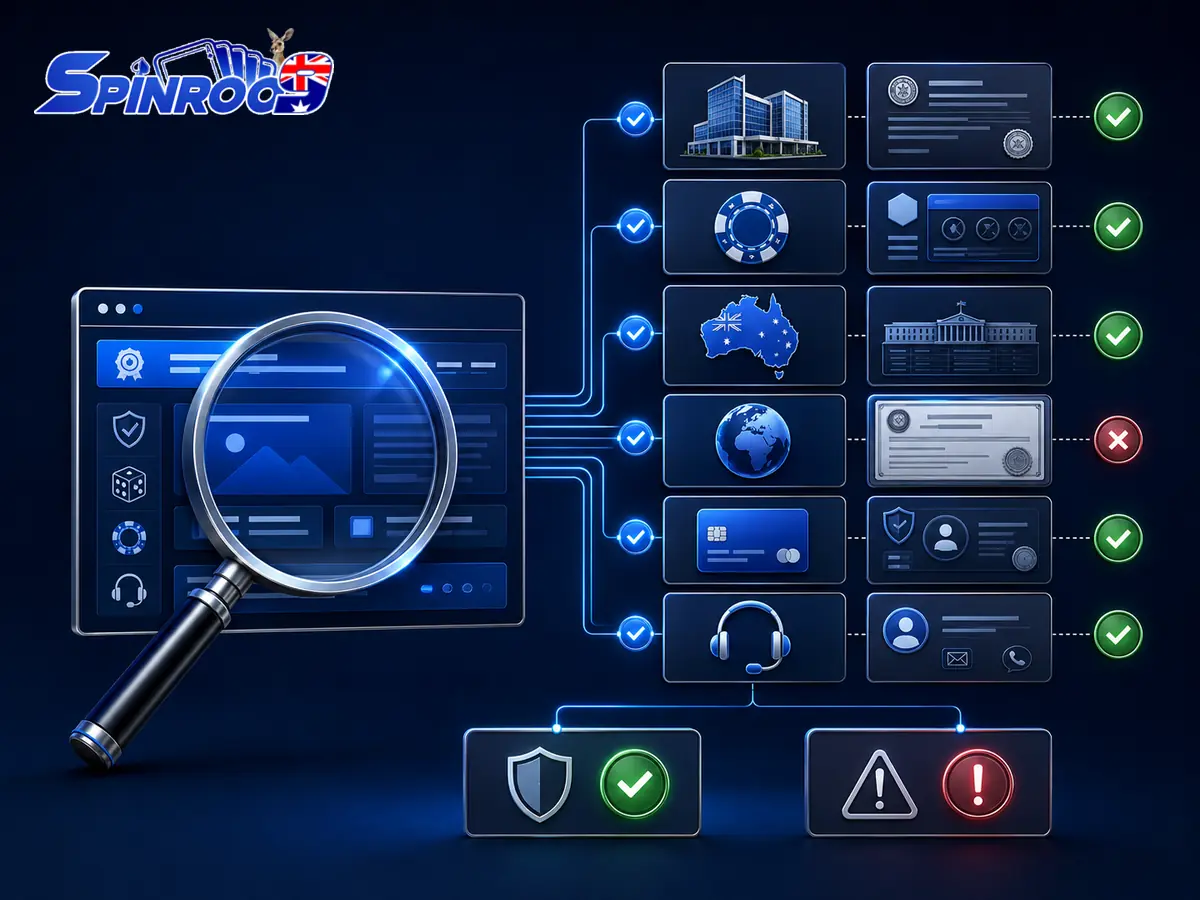
No single design flaw proves illegality, but a cluster can show that claims are not trustworthy. Watch for an invented “Australian casino licence”, a regulator name that does not exist, copied seals with no link, terms naming a different brand, no legal entity, constantly changing domains, instructions to use a VPN or statements that PayID proves local approval.
Payment and support behaviour can add risk: unrelated personal recipients, release fees, pressure to deposit again, requests for remote access or one-time codes, and refusal to provide a written complaint process. A polished interface and HTTPS encrypt the connection; they do not verify the business or resolve the service category.
ACMA's blocked-site information can provide enforcement context, while the PayID payment guide addresses recipient checks. If gambling advertising appears to promote a prohibited service to Australians, ACMA provides complaint information through its official pages.
Before using a gambling service, check the service category and operator through current official sources. If a payment has already been made and seems fraudulent, contact the bank or payment provider promptly through its official channel. Preserve the website address, account details, payment receipt, recipient, messages and terms without sharing credentials publicly.
For a suspected illegal online gambling service or advertisement, review ACMA's complaint and consumer-protection information. For privacy issues, identify whether and how the OAIC or another authority may apply. For gambling harm, Gambling Help Online offers free, confidential support across Australia. BetStop is the national self-exclusion register for licensed Australian online and phone wagering providers; its scope should not be misdescribed as covering illegal online casino services.
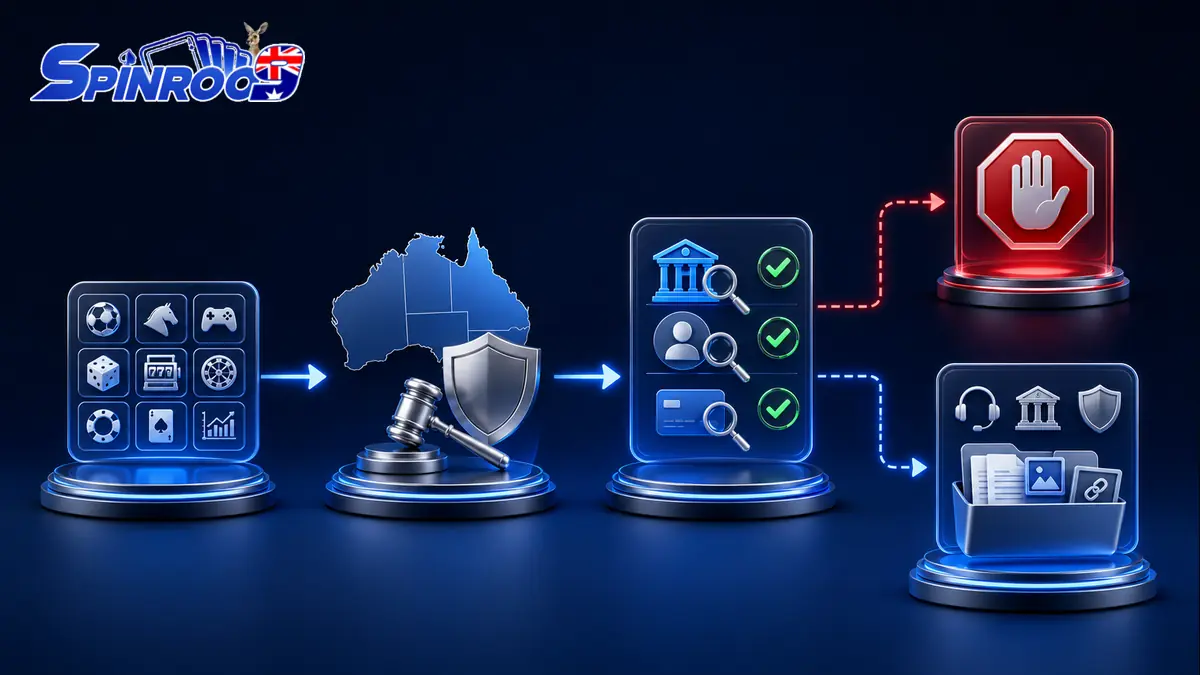
ACMA states that providers are prohibited from offering certain interactive gambling services to people in Australia, including online casino games and online slot-machine services. The precise facts and law matter; check current ACMA guidance rather than relying on a website claim.
No. Accessibility is not a legal approval. A domain may remain reachable before enforcement, use changing addresses or be hosted overseas. Identify the service category and provider, then use official Australian sources.
No. An offshore authorisation does not override Australian restrictions. It may describe status in another jurisdiction, but the Australian service category and customer connection still need to be assessed.
It is an official register of licensed interactive wagering providers. It does not function as a list of approved online casinos, and an entry should not be extended to unrelated products or domains.
No. PayID is a bank-account identifier and payment route. It does not certify the website, operator, licence, service category or withdrawal process.
ACMA publishes information for complaints about illegal online gambling services and advertising. Use the current official ACMA website and preserve the domain, messages and payment evidence.