
Game-level information
Rules, stake range, symbols, features, stated RTP version, jackpot logic and technical documentation.
A game provider may create software, but that does not automatically verify the website offering it. Learn which entity is responsible for each claim.
A casino game provider usually develops or supplies game software. An aggregator distributes multiple studios' games, while an operator controls the customer website and account relationship. A recognised studio name does not prove an operator is lawful or a displayed game is authentic.
Casino websites often show long rows of studio logos, which can make the supply chain appear simpler than it is. A game provider generally designs software and mathematical rules. An aggregator connects a catalogue of games to operator platforms. An operator manages the consumer-facing website, account, terms, payments and support relationship. Hosting, identity verification and payment processing may involve additional vendors.
Responsibility follows the claim. A paytable question belongs to the game documentation. A deposit or withdrawal issue belongs to the operator and payment channel. A statement about Australian legality should be checked against the relevant official authority, not inferred from a studio logo. Keeping these roles separate prevents a familiar game brand from becoming an accidental endorsement of an unrelated website.

A provider may control artwork, audio, game logic, symbol mapping, paytables, feature rules, theoretical return configurations and technical integration. Depending on the product, it may publish help files or certification references and maintain different versions for different markets. The exact division varies by contract, so “powered by” is not a complete description.
A provider generally does not decide whether a particular player's withdrawal is approved, whether a bonus was applied correctly or whether an operator's PayID recipient is genuine. Those questions relate to the customer account or payment arrangement. Sending identity documents to a game studio because an operator has delayed a withdrawal is therefore unlikely to be the right escalation path unless the studio itself confirms a relevant role through an independently verified channel.
Rules, stake range, symbols, features, stated RTP version, jackpot logic and technical documentation.
Account ownership, bonuses, deposits, KYC, withdrawals, complaints, privacy and service availability.
Two games can share a title and visual theme while using different stake options, jurisdictions, jackpot connections or theoretical return settings. A comparison that records only the title is incomplete. The game information panel, version identifier and operator terms are better evidence than a screenshot from a different website.
Before quoting an RTP or feature rule, record the source and context:
Spinroo9 does not publish a universal provider RTP table because a single number can erase the version differences a reader actually needs to check.
“Certified RNG” and “independently tested” sound reassuring, but they are incomplete without the laboratory name, report scope, date, game version and jurisdiction. A logo image can be copied. A useful claim should lead to evidence that can be checked through the testing organisation or regulator, and the evidence should cover the software being discussed rather than a different company or product.
A generic “licensed and certified” badge with no issuing body, licence number, scope or verifiable destination should be treated as marketing—not proof.
A familiar lobby tile does not prove the underlying game came from that provider. A dishonest site can copy logos, screenshots or titles, and an embedded game can load through a domain that is not obvious to the player. Conversely, a different content-delivery domain is not automatically fraudulent; legitimate services also use hosting networks. The conclusion depends on verifiable relationships, not appearance alone.
Check whether the provider's own website identifies approved distribution partners where such information is published. Inspect the game information screen for the developer name and version. Do not install browser extensions, remote-access software or unofficial mobile packages merely to make a game load. If an operator says a security warning must be bypassed, stop.
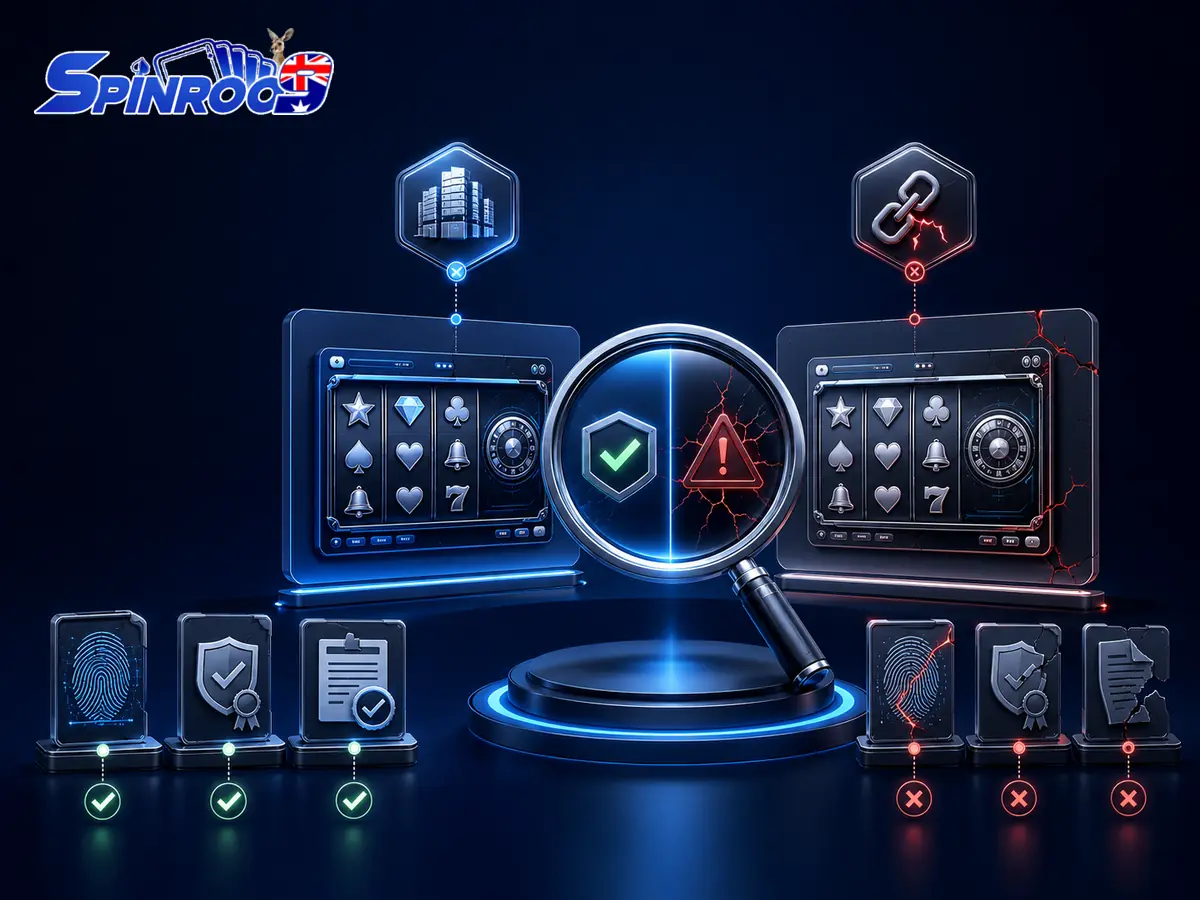
A provider may advertise mobile compatibility, fast loading, portrait play or broad browser support. Those are technical features. They do not prove the game is fair, the operator will honour a withdrawal, the service may legally be offered in Australia or the payment recipient is genuine. Keeping categories separate prevents a positive technical test from becoming a general trust label.
| Claim | Relevant evidence | Not enough by itself |
|---|---|---|
| Game loads on mobile | Direct functional test on supported devices. | A licence badge or studio reputation. |
| Random outcomes were tested | Traceable laboratory or regulator evidence covering the version. | “Certified” text in the lobby. |
| Operator may serve Australians | Current official Australian rules and register where applicable. | A provider logo or .au-themed design. |
| Payment recipient is correct | Independently verified operator instructions and bank confirmation screen. | The fact that a game studio is well known. |
Provider information deserves extra scrutiny when a website uses misspelled studio names, low-resolution copied badges, broken help screens, no game-version details or a catalogue that changes after a deposit. Other warning signs include a request to download an unsigned file, disable security controls, use a VPN to avoid location checks, or contact an individual through a personal messaging account for “game verification”.
A site may also imply that a studio guarantees withdrawals. Game suppliers usually cannot promise an operator's payment performance. Likewise, a statement that a provider is “Australian approved” requires a precise authority and scope; it should not be inferred from local imagery or an English-language page.
A player finds a new website showing the logo of a well-known game studio. The operator has no clear company identity and sends a PayID belonging to an unrelated personal name. Support says the studio logo proves the site is trusted.
The player separates the claims. The studio logo may identify a claimed game source, but it does not verify the operator or recipient. The personal-name mismatch is a payment issue requiring independent verification. The player does not transfer money, records the domain and checks current Australian information rather than asking the studio logo to answer every question.
This approach connects three focused guides: verify casino website claims, check a PayID recipient and understand Australian online gambling rules.

A game provider usually develops or supplies game software, rules and technical integrations. It is different from the operator that controls the consumer account, terms, deposits and withdrawals.
No. A familiar studio name or logo does not verify the operator, legal status, payment recipient or withdrawal practices. Each entity and claim needs its own evidence.
Some games or markets may use different versions or configurations. Check the information inside the exact game and record the version rather than copying a percentage from another website.
Look for the named laboratory or authority, report or certificate reference, date, scope and game version. Verify the evidence independently; an unlinked badge is not enough.
Usually the consumer-facing operator manages accounts and withdrawal decisions, not the game studio. Use verified operator support and never send documents to an unrelated contact claiming to represent the provider.